
Moonwalking
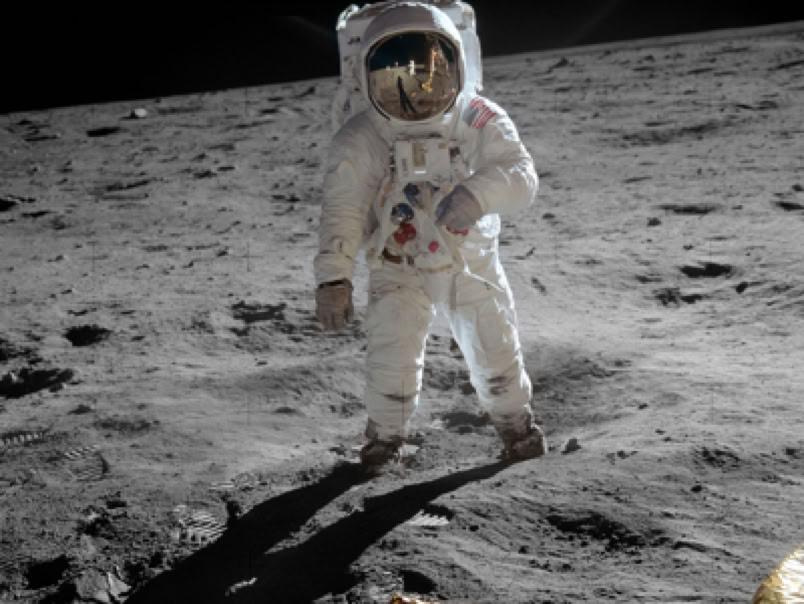
If Apollo Landed on Earth
Sunday, July 20, 1969
The six Apollo moon landings spread across a big part of the face of the moon, mostly not too far from the equator and where previous surveys had been done...
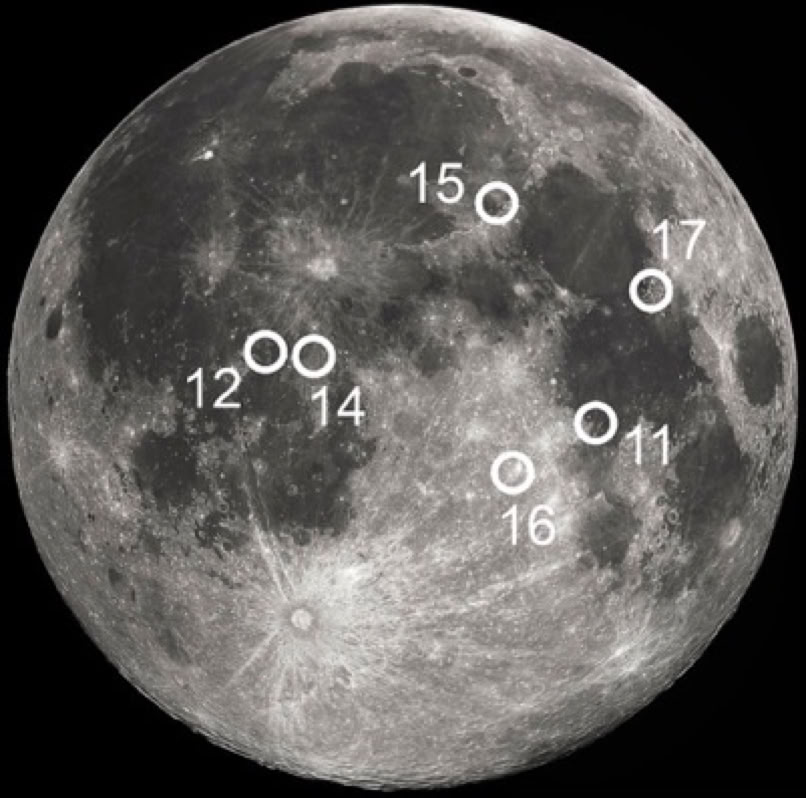
But it’s hard to comprehend how far apart the landings were. So what if they had landed on Earth?
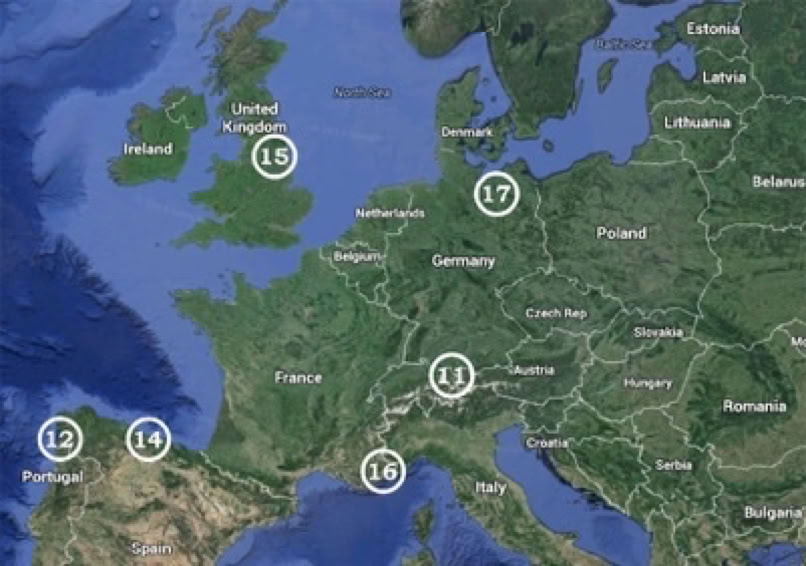
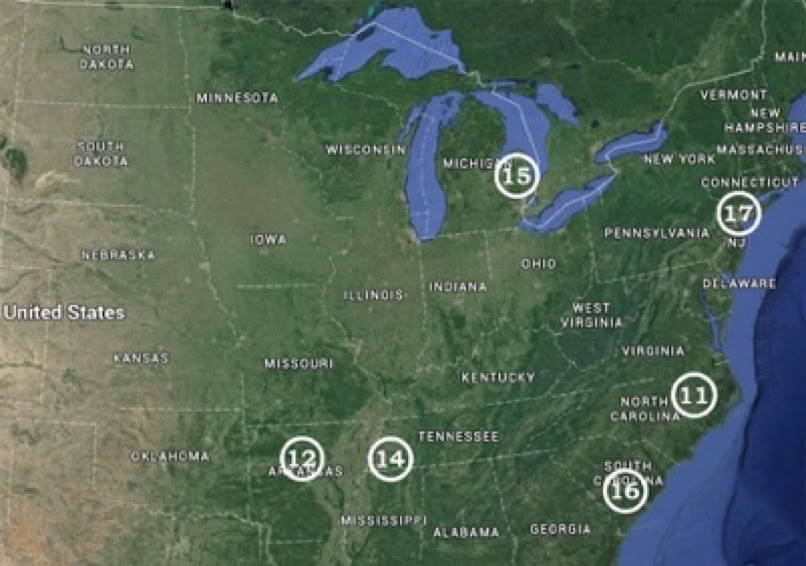
And what of all the Extra Vehicular Activity, or EVA? Just how far did they go once they were on the moon? The Earth equivalent of a home run, to a vacation driving around Paris...
Apollo 11
While Buzz stayed near the Lunar Module setting up equipment, during their 2 1/2 hour EVA Neil walked to the nearest crater no further away than the edge of a baseball field (with the LM on the mound), or not even as far as the opponents’ penalty area (with the LM on the penalty spot).
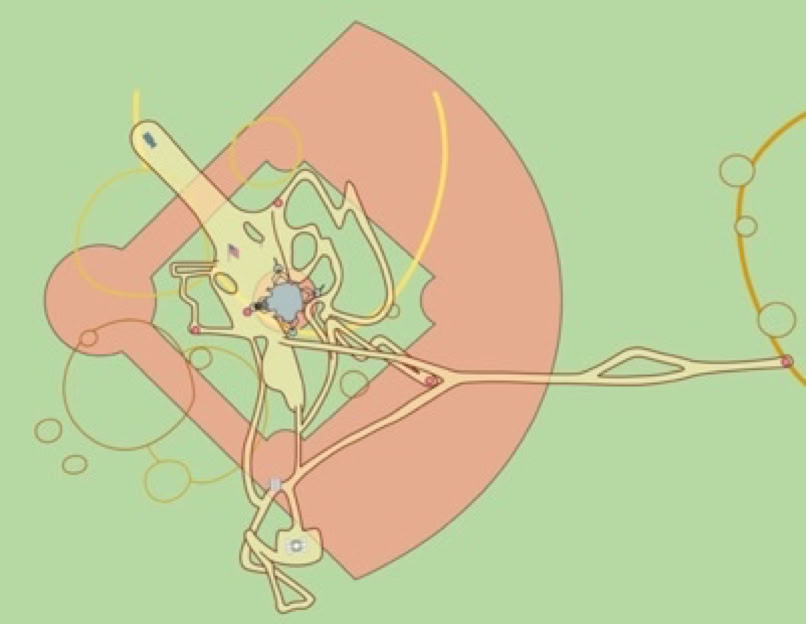
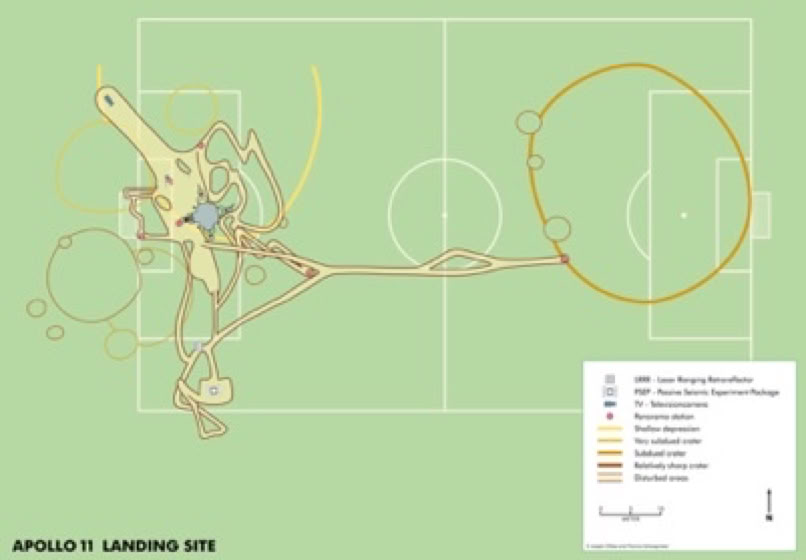
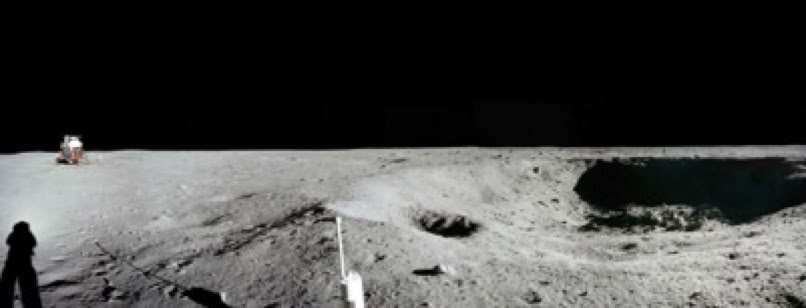
Neil took a panorama from the edge of Little West Crater looking back at the LM; this is the furthest away he got.
“One small step for [a] man, one giant leap for mankind.” - Neil Armstrong
Apollo 12
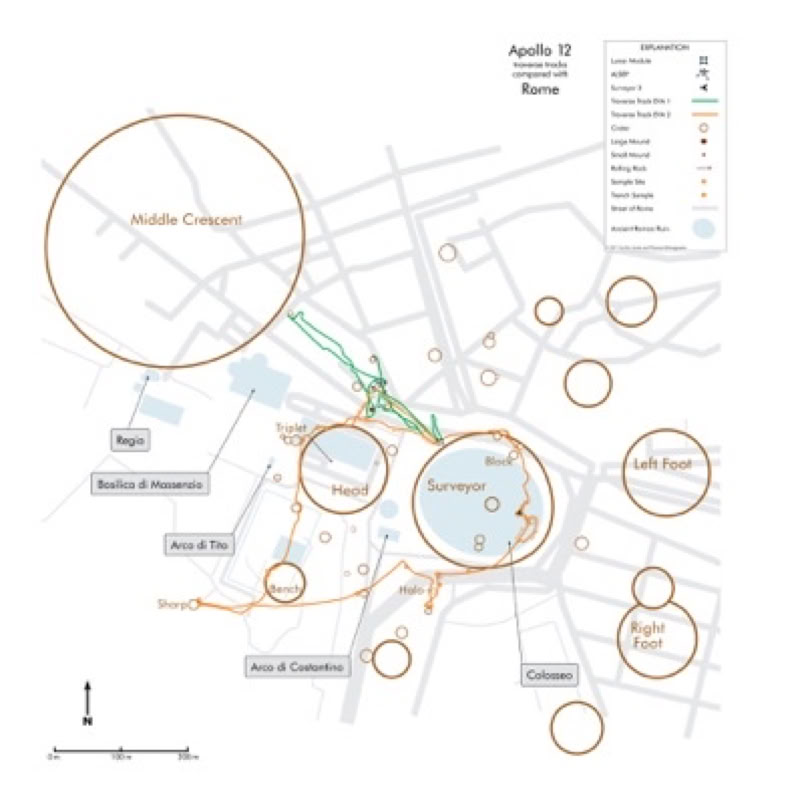
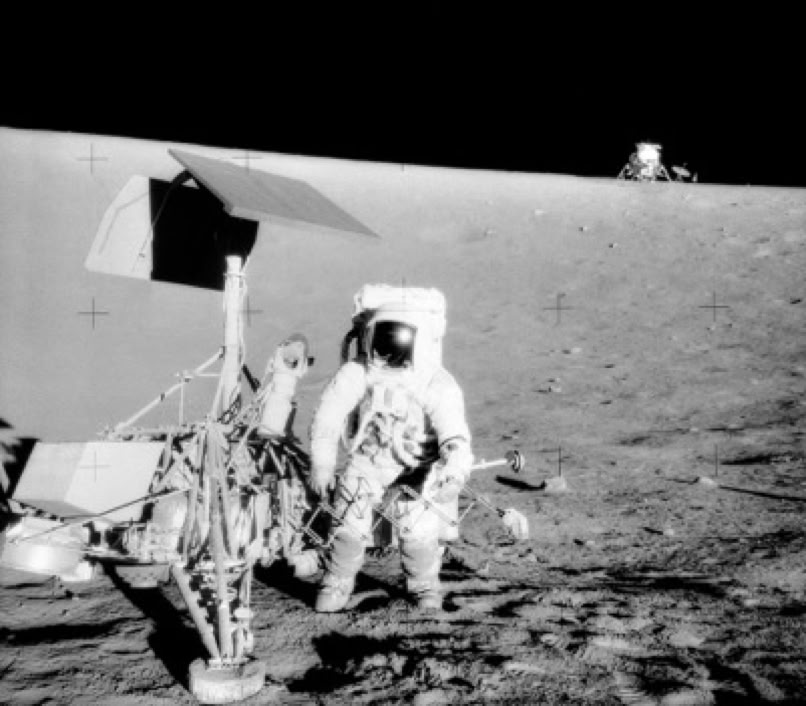
In 7 3/4 hours of total EVA time, Pete Conrad and Al Bean were able to cover a lot more ground. They did a pin-point landing right by the Surveyor lander, both of which would fit into the Colosseum, and their EVAs took them around the Colosseum for a wander round the center of Rome.
Here is Pete taking a look at the Surveyor III:
Apollo 14
Al Shepard and Ed Mitchell would have spent plenty of time in Washington DC and would have been very familiar with the walk along the National Mall from the Lincoln Memorial. During their two EVAs totaling 9 1/2 hours they would walk to the river, and then as far as the Washington Monument.
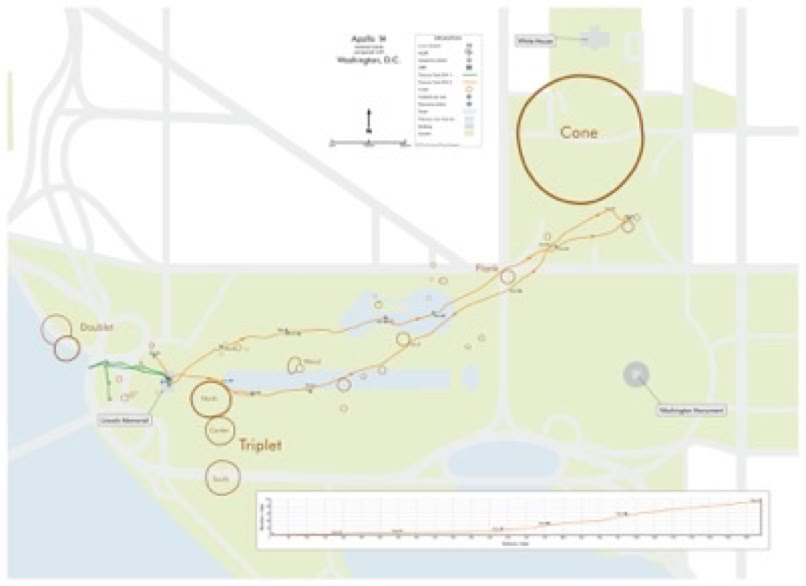
Apollo 14 landed where Apollo 13 had been planned to land, in the Fra-Mauro Highlands. Al Shepard was the first American in space almost 10 years earlier, and after an operation to correct vertigo that had grounded him since his first Mercury flight, he was commander of Apollo 14.
The walk in DC will make your feet tired, but for Al and Ed on EVA 2, it was all uphill and hard to navigate. They were exhausted and had to turn back... they missed Cone Crater, their primary mission target, by about 20 meters!
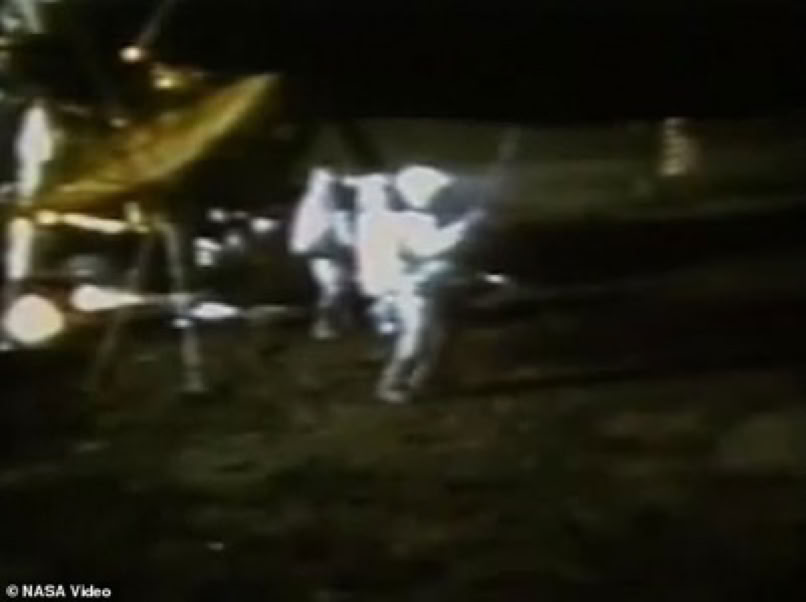
The mission is most famous for Al Shepard playing golf on the moon at the end of EVA 2, which was caught on video by the LM.
Apollo 15
Dave Scott and Jim Irwin flew the first J-mission, which meant that they were equipped to stay on the moon for longer, take longer EVAs and they took the first Lunar Roving Vehicle, or LRV. Their three EVAs totaled more than 19 hours, during which time they drove around much of Manhattan from the UN building west to Times Square on the edge of the Hadley Rille, then past the Empire State Building to West Village, and lastly down to the Lower East Side.
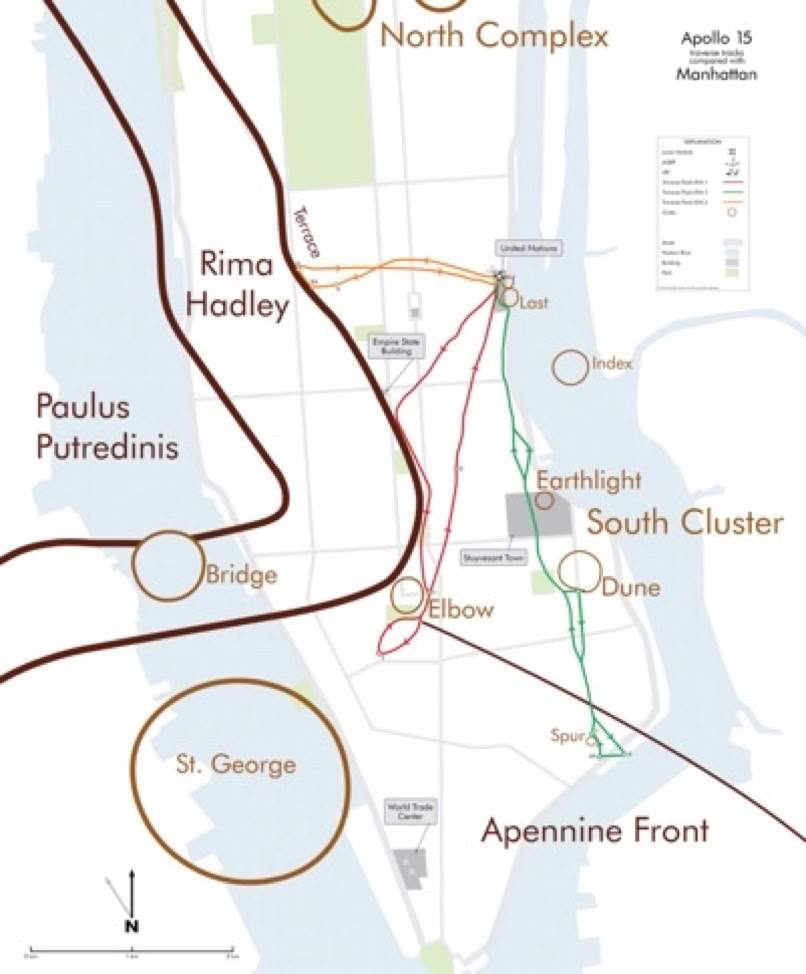
Apollo 15 was lucky. It’s almost impossible to see the lunar surface slope as you get close, and you can’t see a crater if it’s behind the LM as it’s coming down, and once the LM engine kicks up dust it’s a lot down to luck exactly how you land. One of the pads of Intrepid stood in the edge of a crater, causing the LM to lean 11 degrees from vertical. Any more than 12 degrees and the ascent stage can’t lift off again!

Dave Scott smuggled aboard 400 first day covers (stamped envelopes) that would later be sold for a lot of money as ‘flown artefacts’. The astronauts were each paid $7,000 ($40,000 in 2020 money) by a stamp dealer for 100 envelopes, and each astronaut kept 100 for themselves. When NASA found out about it after the mission, the astronauts paid back the money and got grounded (they had been back-up crew for Apollo 17 and were replaced). None of them flew in space again.
Apollo 16
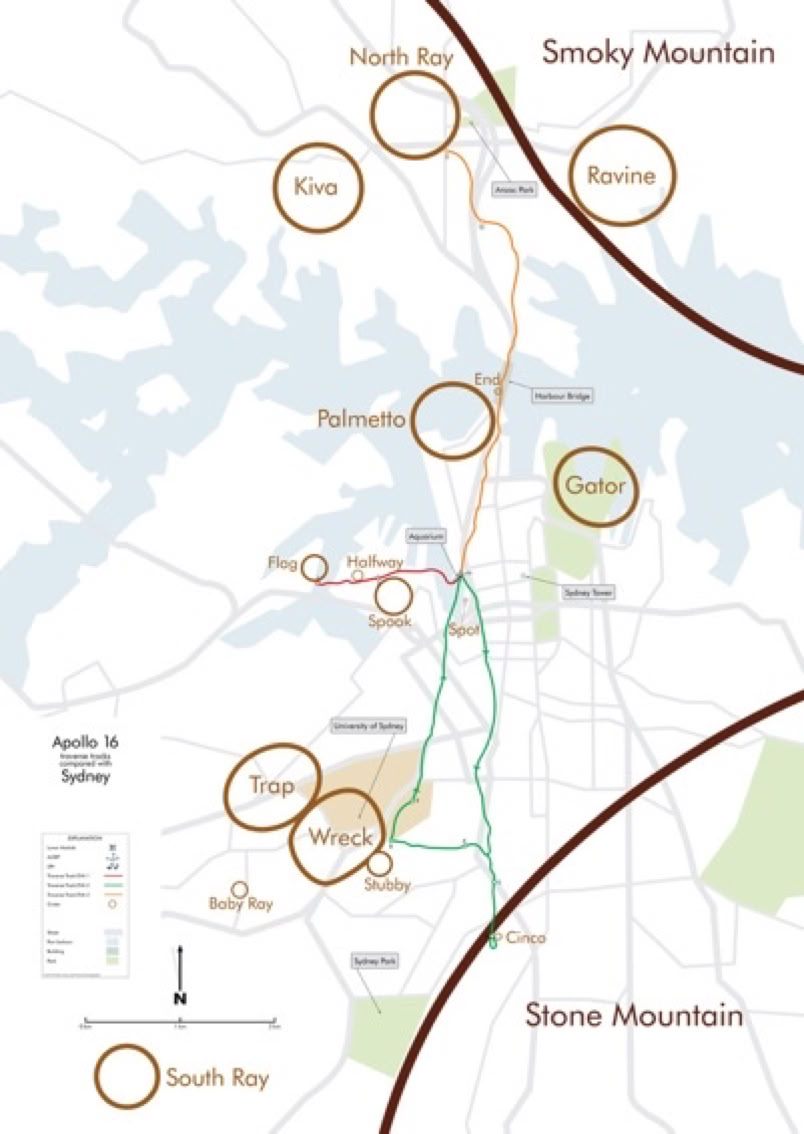
John Young and Charlie Duke also had an LRV for their three EVAs and over 20 hours on the lunar surface. They would have managed to drive the length of Sydney. With the LM parked in the harbor, they would have crossed the harbor bridge to get to North Ray Crater, and Stone Mountain would have been the same distance to the south of the city.
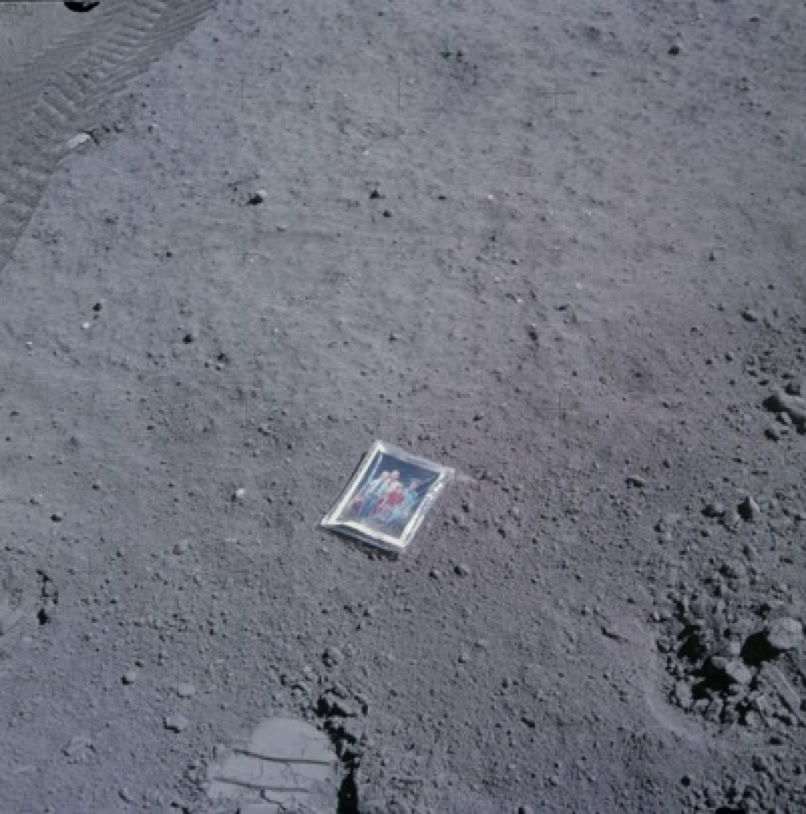
On EVA 3, on his last day on the moon, Charlie Duke left behind a family photograph on the dusty lunar surface. It has probably faded already spending two weeks a month in unfiltered sunlight, but it will be millions of years before meteorite impacts cover it with dust.
Apollo 17
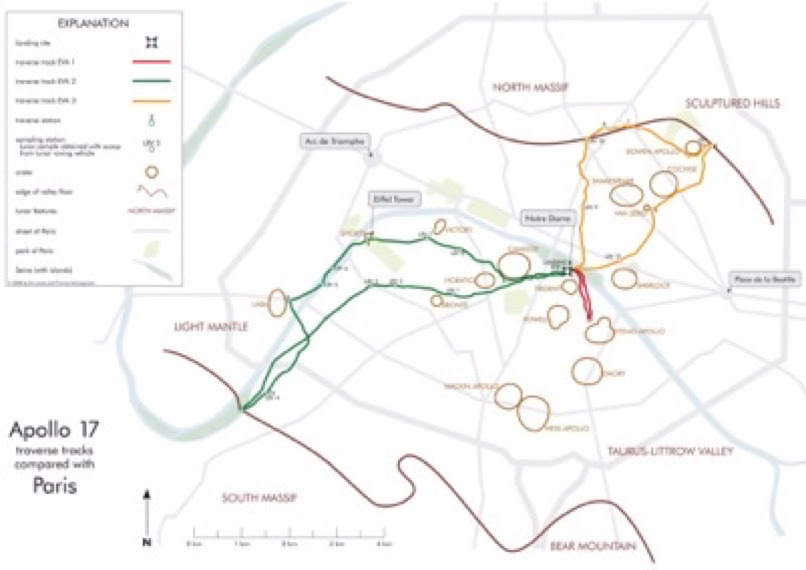
Last but not least, in three EVAs lasting over 22 hours, Gene Cernan and Harrison “Jack” Schmitt would have driven from the LM at the Notre Dame west to the Eiffel Tower and all the way along the Seine to the edge of Paris, 7.6 km from the LM, and back, and then almost as far north as the Sacre Coeur.
Apollo 17 was the first mission where none of the crew had been test pilots. Having taken Joe Engle’s seat (Joe had been a test pilot), Jack Schmitt was the first civilian astronaut; he was a geologist and was the expert in the rocks the mission was sent to find... they were looking for ancient rocks and found orange soil that contained glass beads from old volcanic activity.
They also sampled rocks at the site of a huge landslide (Station 2 on the map below, past the Eiffel Tower and as far south-west as they got along the Seine on the map above). The landslide was caused by ejecta from the Tycho crater 2000 km (1300 miles) away. That is the same distance from Athens to Paris. The impact at Tycho sent ejecta out in all directions, forming rays. One of the rays extends as far as the Taurus-Littrow site where Apollo 17 landed.
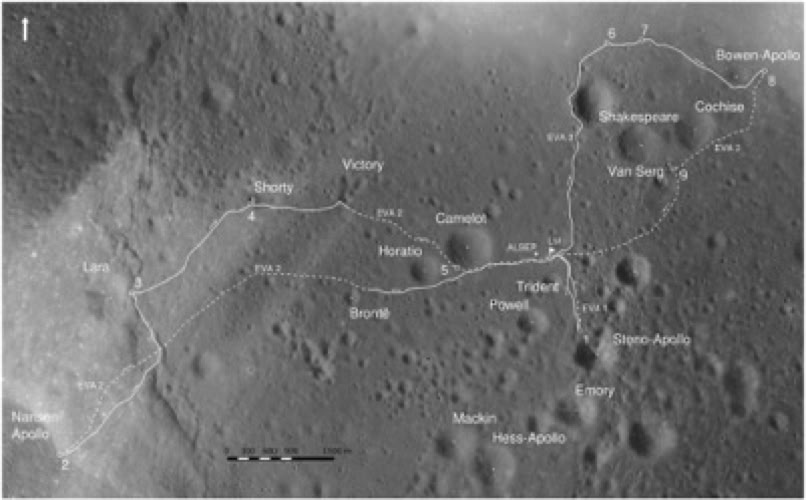
Scientists (Arvidson et al) were able to age when Tycho was formed to about 100 million years ago using these samples. Here is their map of the landslide and where ejecta fell right at the landing site...
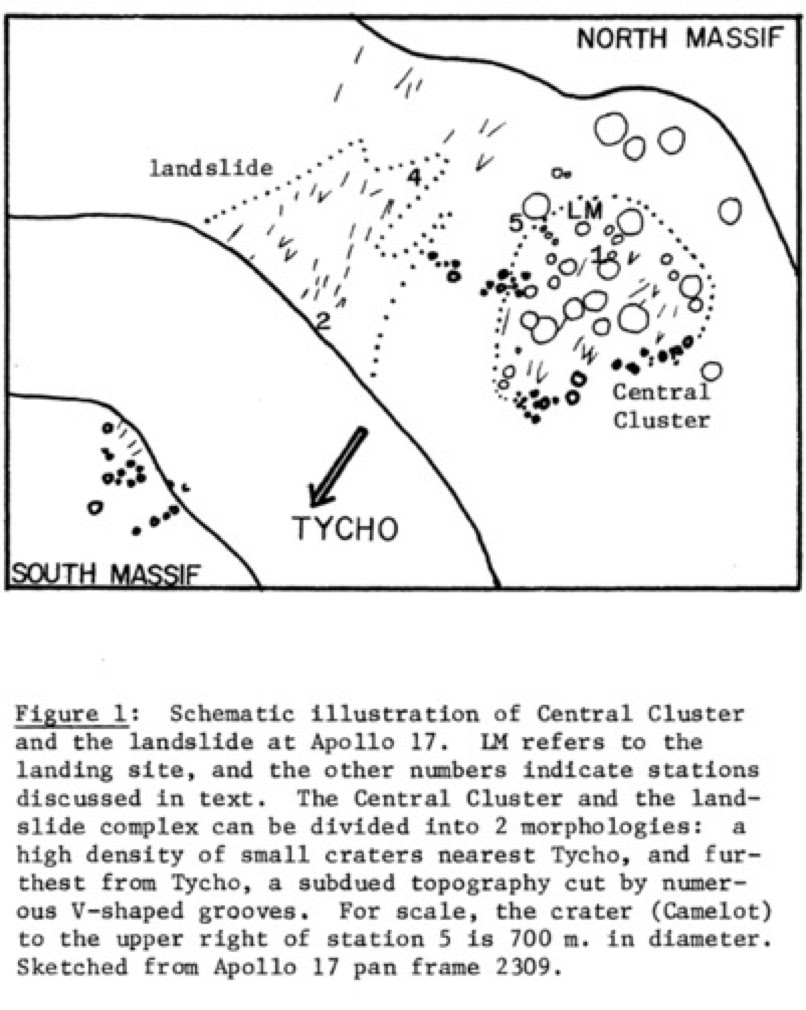
And now LRO shows clearly where that landslide was - the light material at the foot of the South Massif. And the Central Cluster of craters formed by impacts of ejecta from Tycho.
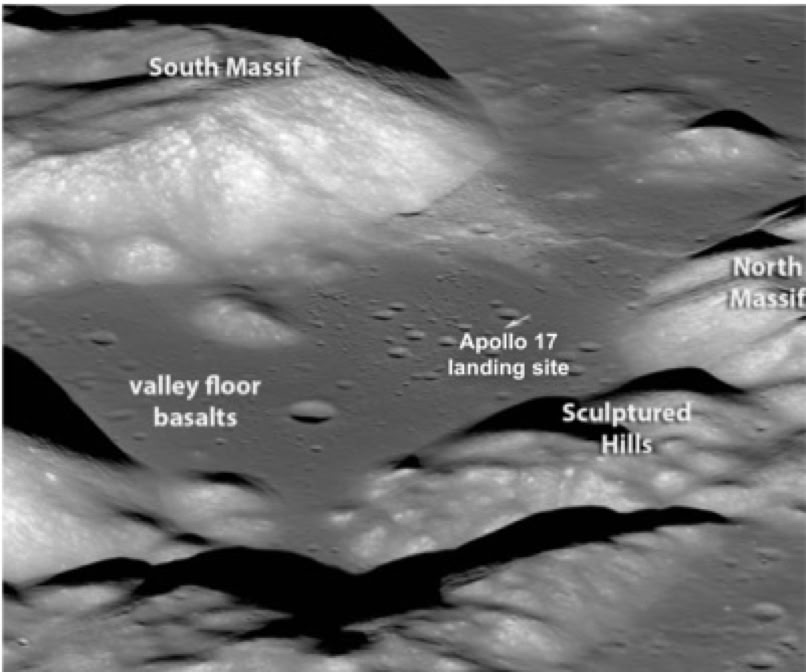
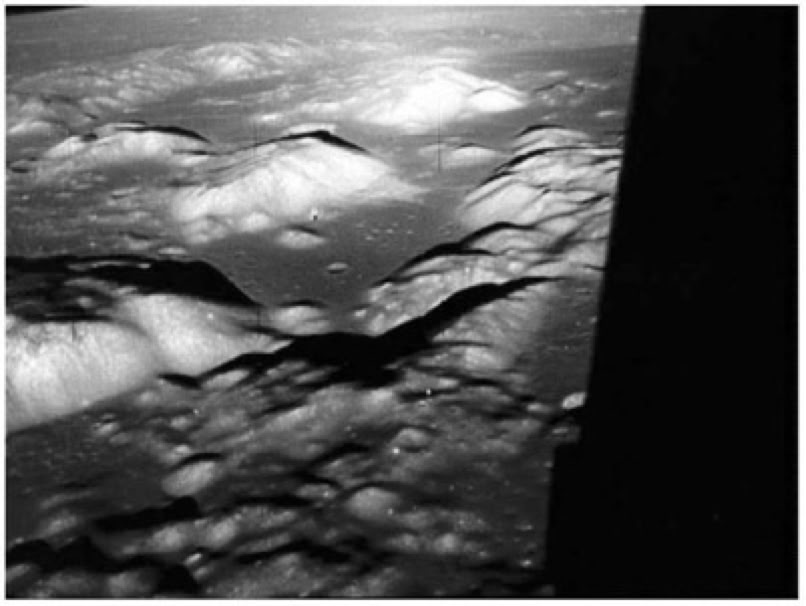
Compare that LRO view to the one Gene Cernan had coming in to land...!
Apollo 17 flew five mice called Fe, Fi, Fo, Fum and Phooey. The mice stayed on board the Command Module and didn’t get to land on the moon, but Ron Evans, the Command Module pilot, and those mice hold the record for the most orbits of the moon, having circled 75 times while Gene and Jack were pootling around Paris finding rock samples.
So, why did they park the LRV 150 meters away from the LM and walk the rest of the way? So that the camera on the LRV could film Challenger’s ascent stage taking off, and leaving the descent stage behind on the moon.
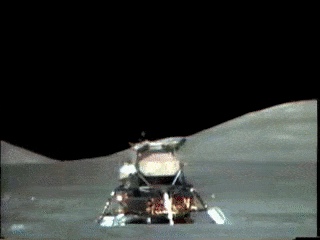
“We leave as we came and, God willing, as we shall return, with peace and hope for all mankind.” - Gene Cernan